A Beginner's Guide to Kindergarten Homeschool
Should I homeschool my kindergartener? Absolutely!
Welcome, Mama! If you're reading this blog post, then you're probably considering homeschooling your kindergartner. Kudos to you for taking initiative in your child's education!
This is the guide!
Read on for support, resources, information on curriculum, learning environment, lesson planning, types of homeschool schedules, supporting arguments (positive ammo for when you get questioned!), and MORE!
First, Some Ugly Truths For New Homeschooling Moms
Whaaa? Yep - no one told you what would really happen when you brought that baby home, but I'm going to tell you the ugly truth that comes with homeschooling. You need to be prepared!
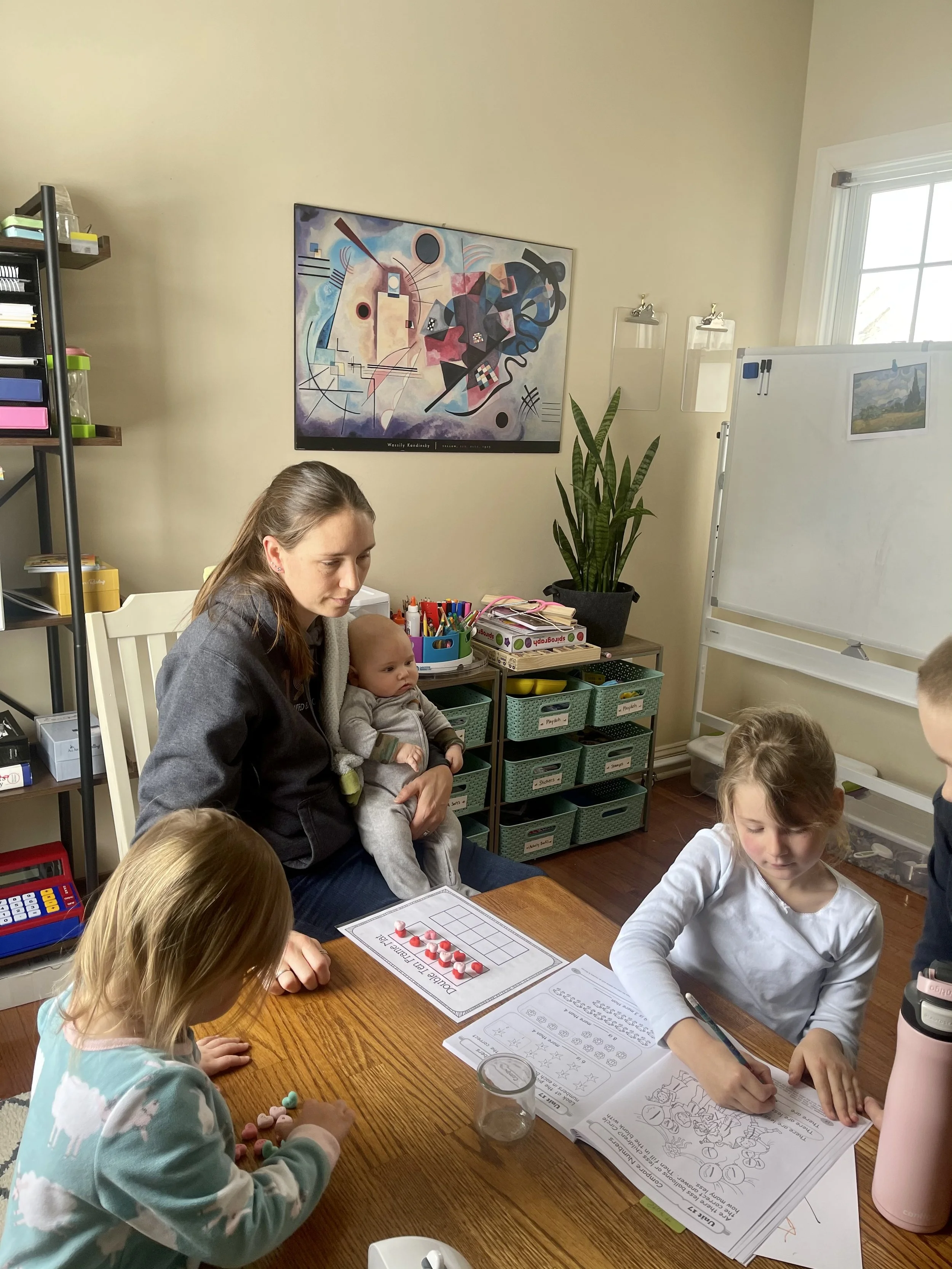
Oh… I look like a tired mess here! This was a few years ago, our 2nd go-around with homeschooling kindergarten - about to start our 3rd round soon!
Here are some intrusive thoughts that might pop up during this messy (but fun!) journey:
doubting yourself more times than you thought possible
wanting both validation and encouragement but not knowing where to turn
feeling judged and self-conscious at times when you share that you homeschool
questioning if you're forgetting to teach any basic skills
assuming they're missing fun events you got to experience in school
feeling guilty about losing your patience
being sure that you're screwing things up
questioning if they're learning enough
fearing that you're pushing too hard
spending too much money
wondering what other homeschooling moms are doing and how they're doing it
Well, guess what? You already ride this emotional rollercoaster - it's parenting!
Rest assured, because just like with a baby, you will get through all those icky feelings and self-doubt, and you WILL be ok, and so will your kiddo!
Supportive Arguments For People Who Question Why You Want To Homeschool For Kindergarten
First, you don't need to explain your reasoning to anyone. However, if you have a nagging family member that you can't brush off, I have a post specifically written for defending the decision to homeschool kindergarten - it's in a nice way, promise!
Be strong and send those concerned individuals this post and smile - Love you!
Related Reading: The benefits & advantages of choosing homeschool kindergarten: The polite, educated way to stand your ground and get people to stop doubting youIt's Not Perfect - It's a Process
Nothing is all sunshine & rainbows - and being a homeschooling family takes patience and sacrifice. But it comes with awesome rewards! And if you seek it out, it comes with a tribe of people who are LIKE YOU and will support and comfort you when needed.
Buckle up, baby! Take a deep breath and get ready for an extraordinary ride! It's exhilarating!
Where Do You Even Begin With Homeschooling Kindergarten?
Don't worry; I've got you covered with this beginner's guide. I'm a few months shy of starting my third go-around with starting a kindergarten year
I'll share tips and practical advice on beginning the learning process of homeschooling a kindergartner.
First Things First, Do Your Research.
As with any major decision, gathering information and learning as much as possible about homeschooling is essential. Here are things to check out (and I cover below, with resources!):
Look up state laws and requirements, (in PA? I have a Pennsylvania Homeschool Law post)
Read homeschooling blogs and books,
Join homeschooling communities online or in person,
Create a plan for connecting with others and creating friendships,
Get an idea of what you want to teach to help narrow down choosing a kindergarten homeschool curriculum
This will give you a better understanding of what homeschooling entails and will help you make informed decisions for your child's education.
Home Education State Laws & Requirements
HSLDA (Home School Legal Defense Association) is an excellent resource for homeschooling parents to learn more about the laws and regulations regarding home education in their state
From understanding what documents you need to have on hand to knowing which educational activities are acceptable in your state, HSLDA can provide comprehensive information about every aspect of homeschooling
In addition, HSLDA can provide guidance on how to comply with state laws and what steps must be taken if you choose to move your family between states while homeschooling.
With their assistance, parents can rest assured knowing they are meeting all legal requirements and staying compliant with their state.
Don't be afraid to take advantage of the wealth of knowledge available through HSLDA; it could make all the difference in your homeschooling journey
Related Reading: Learn how to homeschool if you live in PennsylvaniaRelated Reading: Keeping Homeschool Records: Organize Your Homeschool Paperwork Like a Pro
Helping Your Homeschooled Kindergartner Socialize & Make Friends
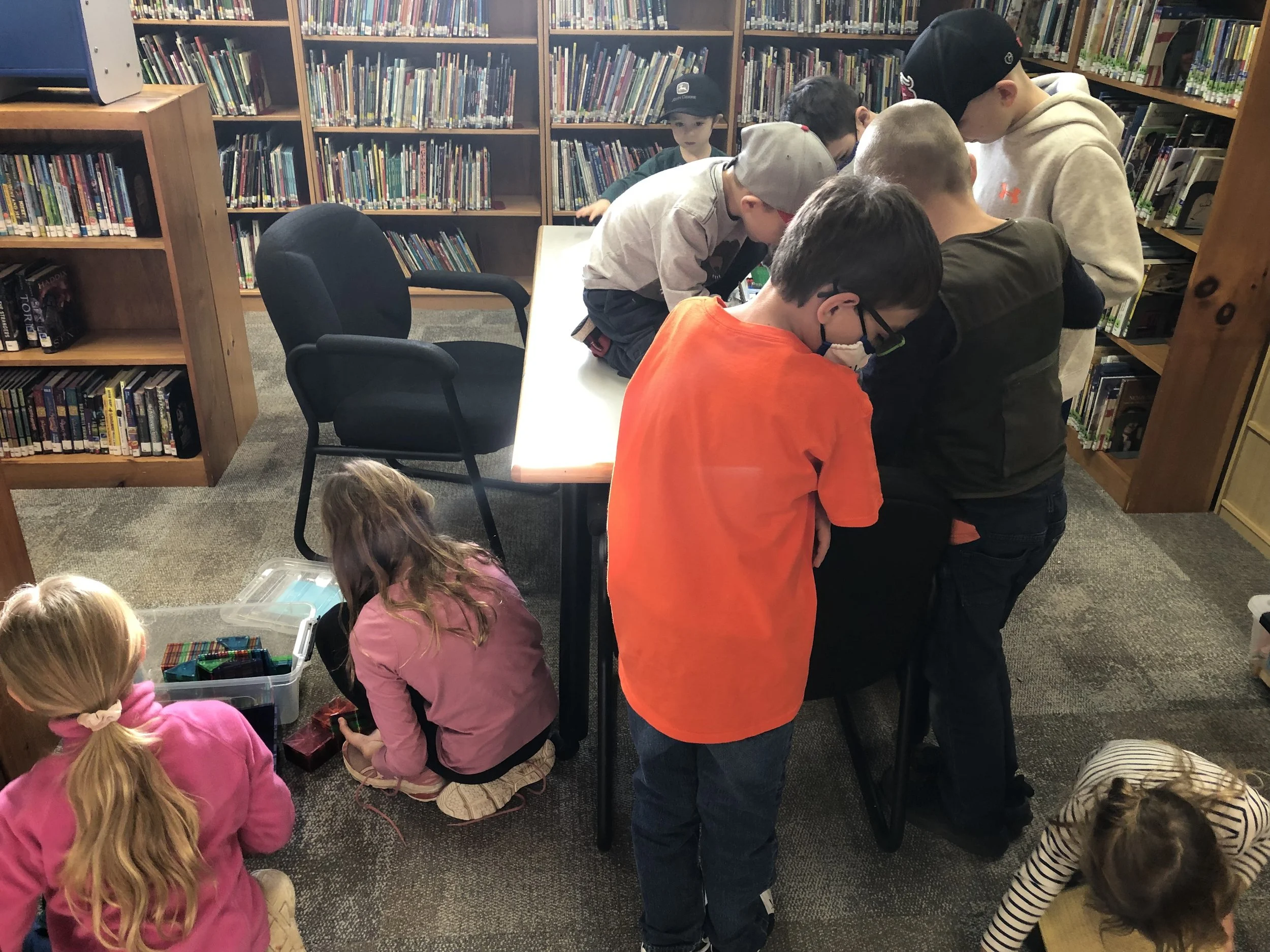
The library that hosts our homeschool group is anything but quiet! We’ve made some good friends from being consistent with this group gathering!
There are tons of resources available online to help you connect with other homeschool families who can offer advice, support, and even friendship.
Socialization and making friends while homeschooling really isn't that hard, I promise! I wrote a post about social linking with a step-by-step on how to make lasting friendships.

One of our Wild + Free homeschool groups had a private class from the Berks County Search & Rescue Team about their Hug A Tree Program, teaching kids how to be safe if they get lost.
Finding Homeschool Communities
From local meetups to online communities, there’s no shortage of homeschoolers eager to learn and share their experiences.
We did our first year of homeschooling without Facebook, and while possible, it was challenging to find like-minded groups and meetups. Finding local homeschooling groups through FB groups made our social life infinitely better - and many times over-scheduled!
We found a fantastic community with Wild + Free without needing FB. You can search their online database for groups local to you.
With a little bit of effort, you could soon be part of an amazing community where you can feel at home while on your homeschooling journey.
Related Reading: How to make lasting friendships as a homeschoolerChoosing a Kindergarten Homeschool Curriculum
Next, choose a homeschool kindergarten curriculum that works for your family. There is no one-size-fits-all curriculum for homeschooling, so it's important to find one that fits your child's learning style and your personal teaching style.
You may not know your style yet, and that's ok! You'll be fine as long as you're flexible about ditching what doesn't feel right. You'll soon realize that many homeschooling families ditch their curriculums often - sometimes mid-year!
We have personally tried five different math curriculums since we started our journey - and guess what? I'm trying a new one for my oldest next year! Kids' needs change, so don't get pigeonholed into any specific curriculum.
Where Do I Find The Best Kindergarten Homeschool Curriculum?
There are tons of homeschool curriculum choices specifically for teaching kindergarten available.
You can find pre-made lesson plans encompassing all the core subjects - these are called boxed sets, or you can piece various resources together to create your own kindergarten curriculum.
There are free curriculum options (though generally not the best quality), video lessons where others teach the lessons (Outschool is a huge source for that), and just about every other option under the sun.
Some don't use any curriculum at all! (not my choice - it presents the opportunity for too many holes!)
Using Cathy Duffy For Finding Curriculum
A fabulous resource (possibly the best) for homeschool curriculum is Cathy Duffy Reviews. This lady has reviews on it all! I have her site bookmarked. I've never bought her Top Guide, but I imagine it's worth every penny if you're overwhelmed with the curricula choices.
Feel free to mix and match, but always remember to prioritize your child's interests and strengths.
The Curricula I Use To Teach Kindergarten
We play—a LOT. But I do have workbooks and pages because my kids like them. If I forced any of it, my kids would hate school, so I don't. It's all about flexibility and finding balance.
By introducing some paperwork young, you're building focus and setting a foundation for skills they'll need as their education requirements progress.
This doesn't mean doing tons of worksheets - mazes, coloring activities like finding letters, colors a set number of apples, etc. are all productive means of learning. Some days we do as a handful, and some days we do none. I always let my kids guide our pacing.
Science
Science is the perfect subject for reinforcing the habit of learning activities at a kindergarten level! The kindergarten year involves lots of tracking the weather, learning the four seasons, and other topics that should be experienced before introducing any worksheets.
You could easily teach kindergarten using only science concepts and have a successful homeschool kindergarten year!
Teaching the Four Seasons
I love teaching the Four Seasons between 4 and 6 years old because they begin to make connections between what they are learning and experiencing. It is an awesome way to set up enthusiasm for learning because they feel the success!
Exploring Nature With Children
For a year-long, whole-nature program, we love Exploring Nature With Children and have found that following along with it makes for a successful homeschool kindergarten year!
It has everything you need with lesson plans, schedules, book lists for the local library, weekly seasonal themes, etc. It's awesome! This is not worksheet based, but you can keep a nature journal for your adventures!
The early learning years should be about hands on activities, free play, and building up fine motor and gross motor skills. Exploring Nature With Children is exactly that with nature walks, read aloud stories, and getting INTO the world with your young child.
I have repeated this one a few times as my kids have gotten older as the material can be adapted easily. However, once my oldest grew out of it, we took a break from science.
Building Foundations of Scientific Understanding
We currently use Building Foundations of Scientific Understanding (BFSU), which says Vol.1 is for K-2, but I'm not convinced they'd grasp the basic concepts so young.
However, we are breezing through it now with my older kids (8 & 9), and I find it developmentally appropriate and fun. I am learning right along with my kids! Apparently my science education really sucked (thank you public school system).
We move much faster than the suggested pacing, so I don't feel we're behind, and I genuinely don't think my children would have understood the lessons at 5 or 6 years old.
If you choose BFSU, join the BFSU Facebook group and buy Early Elementary Science Education. It's an approved supplement, and I teach BFSU from it. The actual curriculum book is insanely confusing with pacing - the supplement spells out the lesson plans in a very manageable way!
Reading Language Arts
When your little one demonstrates proficiency with the Essential 5 Pre-Reading Skills and is ready to try reading instruction, I wholeheartedly suggest All About Reading as the best curriculum.
It's systematically sequenced and has ZERO holes. It's better than what's offered for reading instruction in the public school system. I promise you'll feel like an absolute Boss Homeschool Mom when your kids are breezing through books in a few years because YOU taught them how to read!

This little bookworm always loved stories but really struggled with learning how to read. All About Reading helped her succeed and I’m forever grateful for their curriculum!
Handwriting Without Tears
This is the best program for teaching handwriting, I guarantee it! Setting up good habits for letter formation can make or break writing as they get older. PLEASE set your kiddo up for success with these simple and extremely effective books!
Even though my 4-year-old already copies letter and writes, I will 100% have her complete a few years of the Handwriting Without Tears curriculum to banish inefficient habits and establish a solid foundation for writing.
Here’s been our experience with Handwriting Without Tears and even their cursive programs - we truly use it for years!
We'll start the curriculum seriously around 5 or 6 years old, depending on when she shows maturity and focus for having consistent work that requires quality effort. There are no minimum age suggestions for this curriculum, but I wait. There's no rush!
Math
I don't have nearly the same passion for any specific math curriculum as I do for reading or writing, but I really like Singapore Essentials A & B. It starts slow, and your child feels so successful! But don't be fooled because it builds!
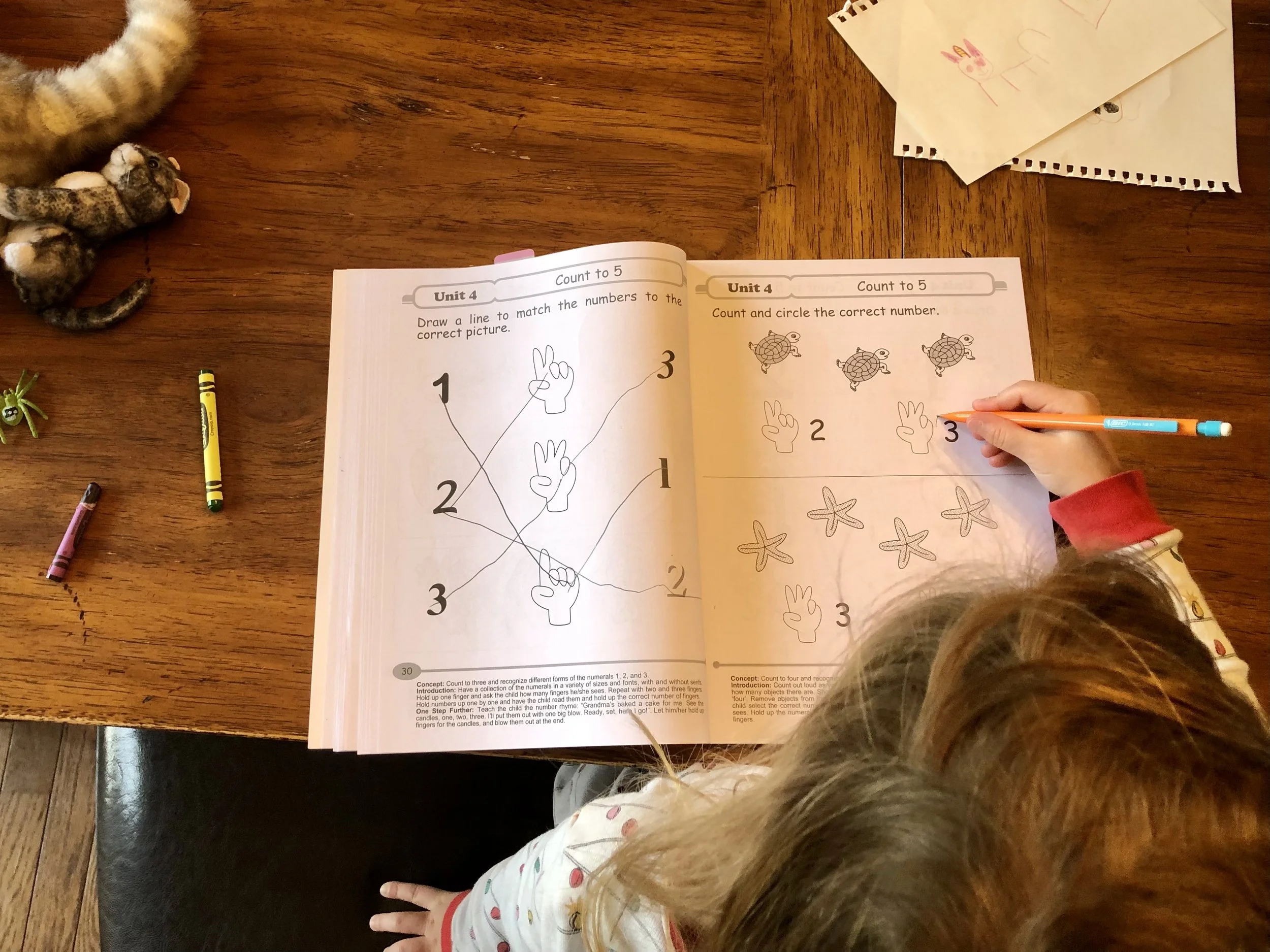
My 4-year-old doing pages from Homeschool Curriculum: Singapore Math Essentials, Book A
Singapore Math is known for being accelerated and challenging - it's not for everyone! We start with this program and billions of math manipulatives, then have historically switched to something else based on the kids' needs.
Singapore gets very dry as it advances and my kids have always lost their motivation. However, it starts off engaging and fun and builds a solid foundation. I have already started my 4-year-old with Singapore Essentials Book A because she has been nagging me to do work like her older siblings!
Creating Learning Spaces
Set up a designated learning environment someplace in your home. It doesn't have to be a separate room. Any well-lit area with a table and space for supplies works! I recommend starting with a clean, uncluttered space.
With some creativity and planning, you can transform any room into a cozy and motivating homeschool environment that can make learning fun and different from free play.
That's not to say you can't learn anywhere - you can! We frequently take lessons to the floor, the trampoline, the kitchen table, and the park - my oldest did his reading lesson on the bathroom floor today when his littlest sister needed a bath!

You can set up a perfect homeschool learning space, and chances are, your kids will go rogue. This particular one of mine prefers anywhere over an actual table. The poor guy actually cried during his brief time in kindergarten for having to sit for too long.
Why A Designated Learning Space Can Be Helpful
However, it is nice to have a home base that means business. A set space will create a predictable location to help your kindergartner focus and stay on task during their lessons and activities. Sometimes when focus or attitudes are squirrely, taking it to the table is enough to get things back in line.
Setting up a homeschool space can seem daunting at first, but taking it one step at a time will help you create a joyful learning area where your kindergartner can thrive.
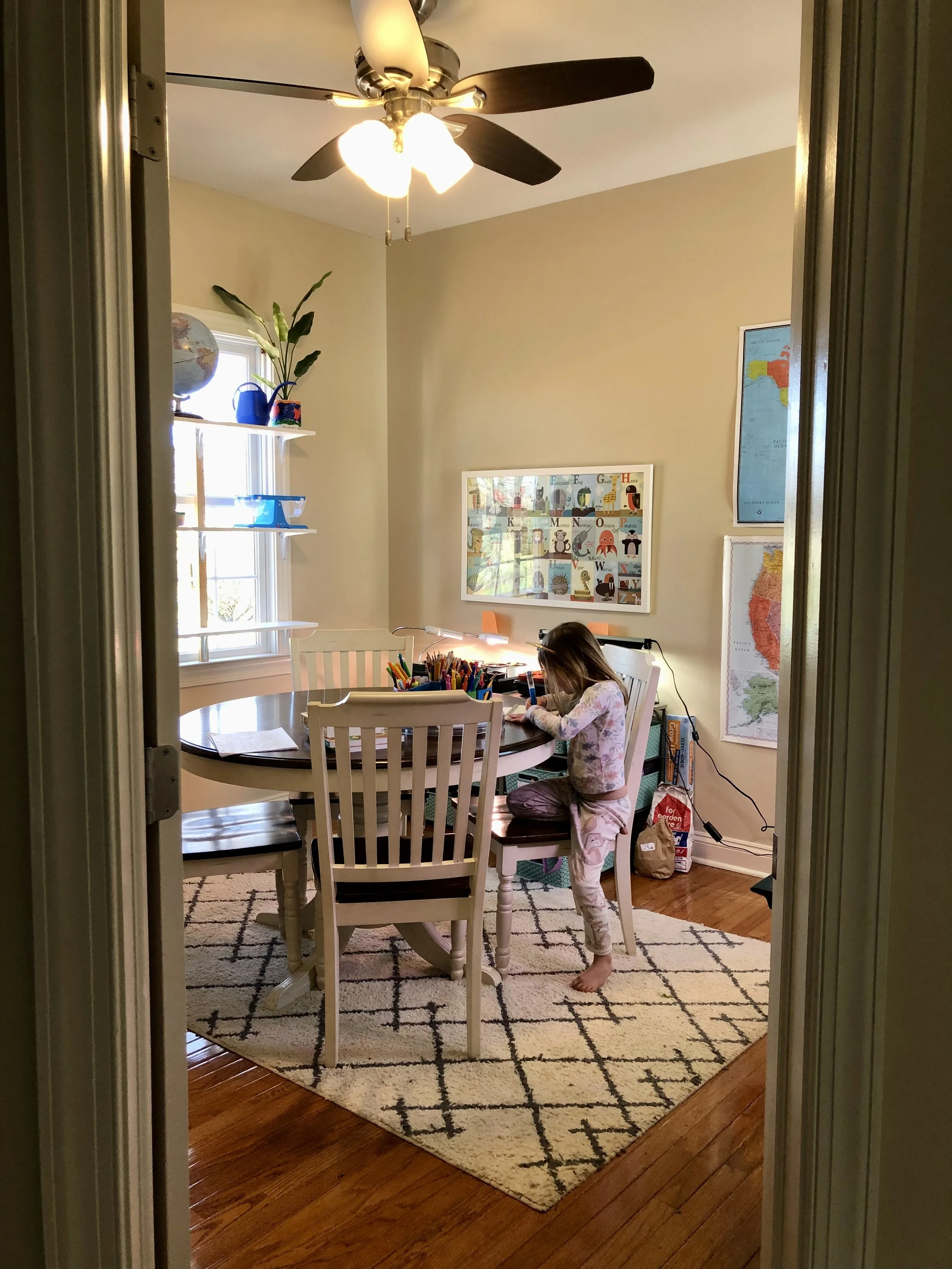
This little girl knows the back room table is for working. She’s about to start her kindergarten year in a few months and she couldn’t be more excited!
Keep Your Learning Space Decor Flexible
You can decorate your learning area with posters, charts, or artwork to make it fun and inviting for your little one.
I know some parents like to allow their children to get involved in decorating the area with inspiring pictures or photos of their favorite characters. I'm not that cool.
I've always found that when I let my kids decorate, I end up hating and regretting it. Thus, our learning space is all my design, baby. I don't want to get frazzled looking at random kid stuff all the time. Our wall paint is hideous, but I’d rather look at that than Paw Patrol or Harry Potter everywhere.
However you decorate, remember that it needs to be a living space with the flexibility to change based on your child's progress and needs.
We currently have a world map and USA maps on the wall, but they used to be alphabet posters and number charts. Guess what? I need to put the letters and numbers back up for our youngest!
The only constant decor is our magnet whiteboard (36x24) and cork bulletin board - everything else keeps changing!
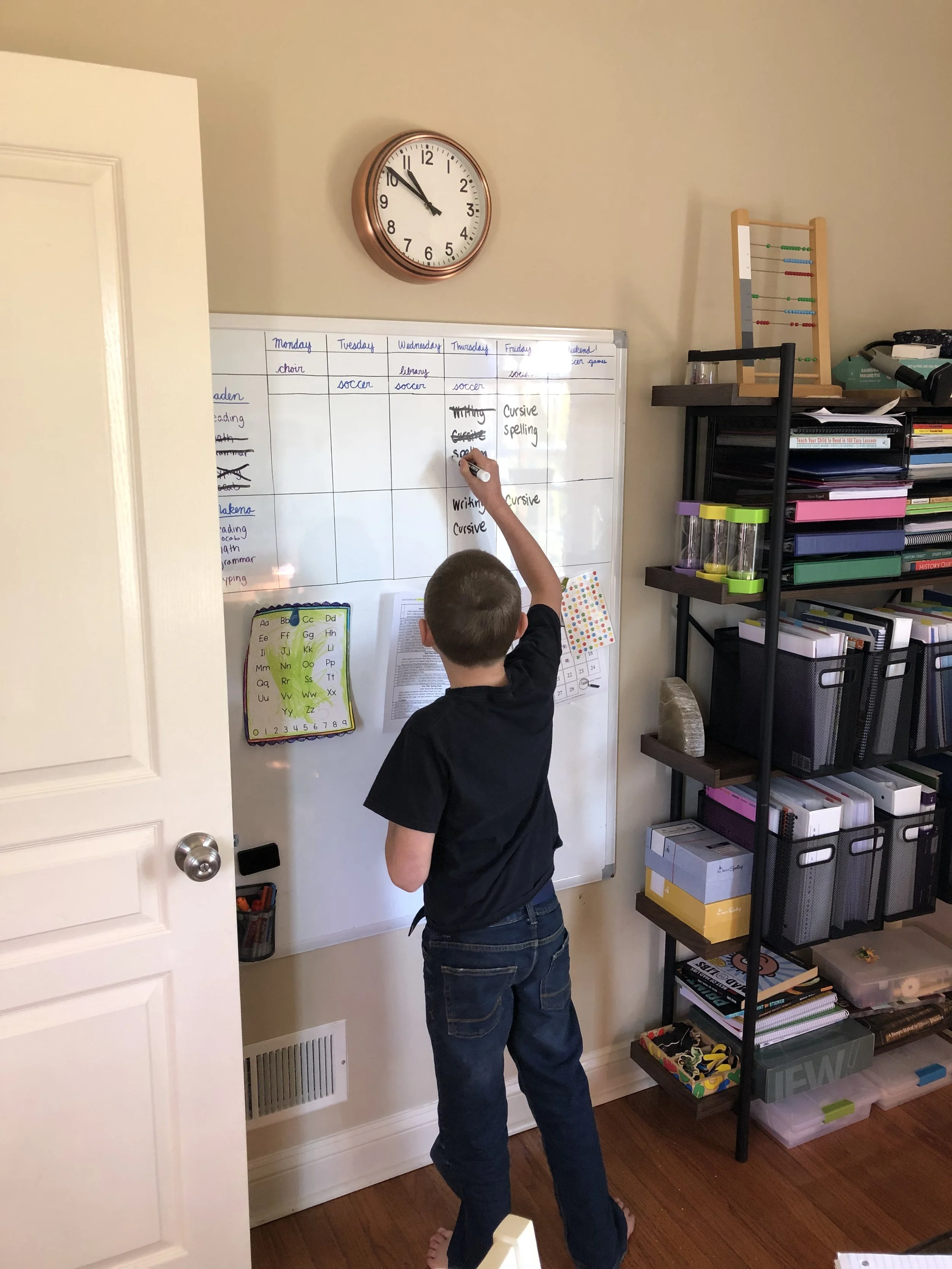
Our homeschool schedule board in action! This whiteboard is the bread & butter of the room - the kids love it! I am constantly finding random drawings of… things… on the bottom of the board.
Homeschool Organization
This will evolve as you start to acquire alllllll the things. Right now I have:

These are shoe racks with bins holding paper, stamps, stickers, math items, alphabet stuff, etc. Each kid has their own bin for random stuff. Kids tend to collect things…
a bookshelf that holds file containers of current and growing curriculum,
a plastic container for the old curriculum
a cabinet for overstocked arts & crafts supplies
2 shoe racks with containers holding rotating supplies (paper, puzzle books, stamps, etc.)
magnetic whiteboard - this is big (36x24), but also too small. The kids LOVE drawing on it
way too small cork bulletin board - honestly, the whole wall should probably be cork...
Cubbie shelves for my 10 billion kids' books (remnants from my classroom library!)
I also tend to horde school things - probably from my days as a teacher...

This is our curriculum shelf - the wire bins are fantastic! Each bin has a purpose. Each kid has a single bin with all of their workbooks & each reading level has a bin. I have random catch-all bins, too.
You will also start to collect. It's a thing - just know that there's a great market for used homeschool stuff, so don't trash anything!
Creating A Homeschool Schedule and Lesson Planning
Once you have your curriculum, hunker down and get your homeschool schedule outlined. It doesn't haven't to be as scary as it sounds!
I can teach you how to create the perfect schedule and I have free homeschool schedule PDF templates you can use.
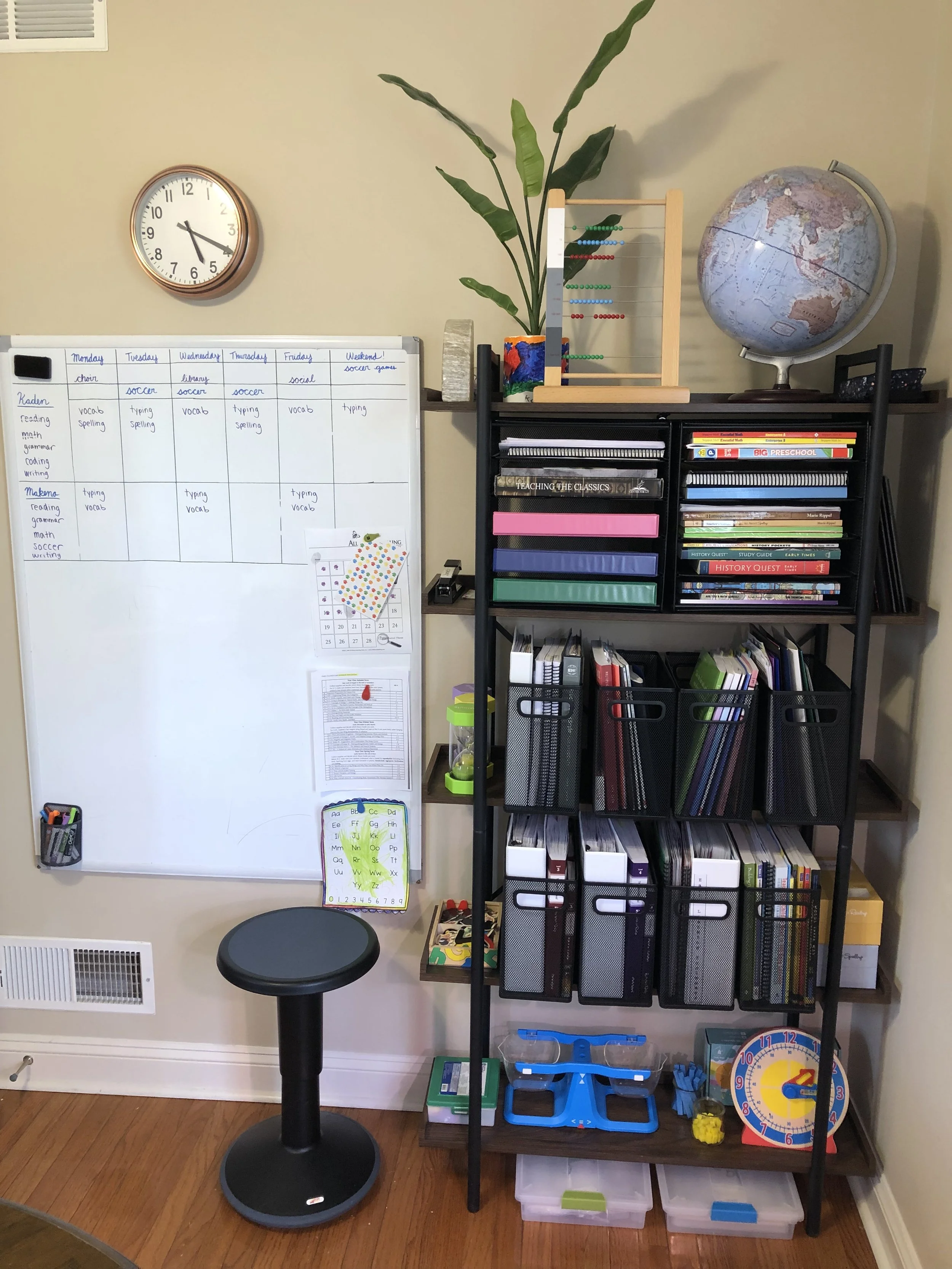
Another view of our homeschool schedule and lesson plan board. We erase the days as they’re done & I write in the new tasks on Sunday. Plus, our curriculum shelf.
As you see with our current schedule, this wouldn’t work for kindergarten. They can’t read it! It could work to keep YOU organized, though!
When the older kids were both little, we used a pocket chart calendar, and I drew (horrible) pictures on post-it notes and stuck them to the days.
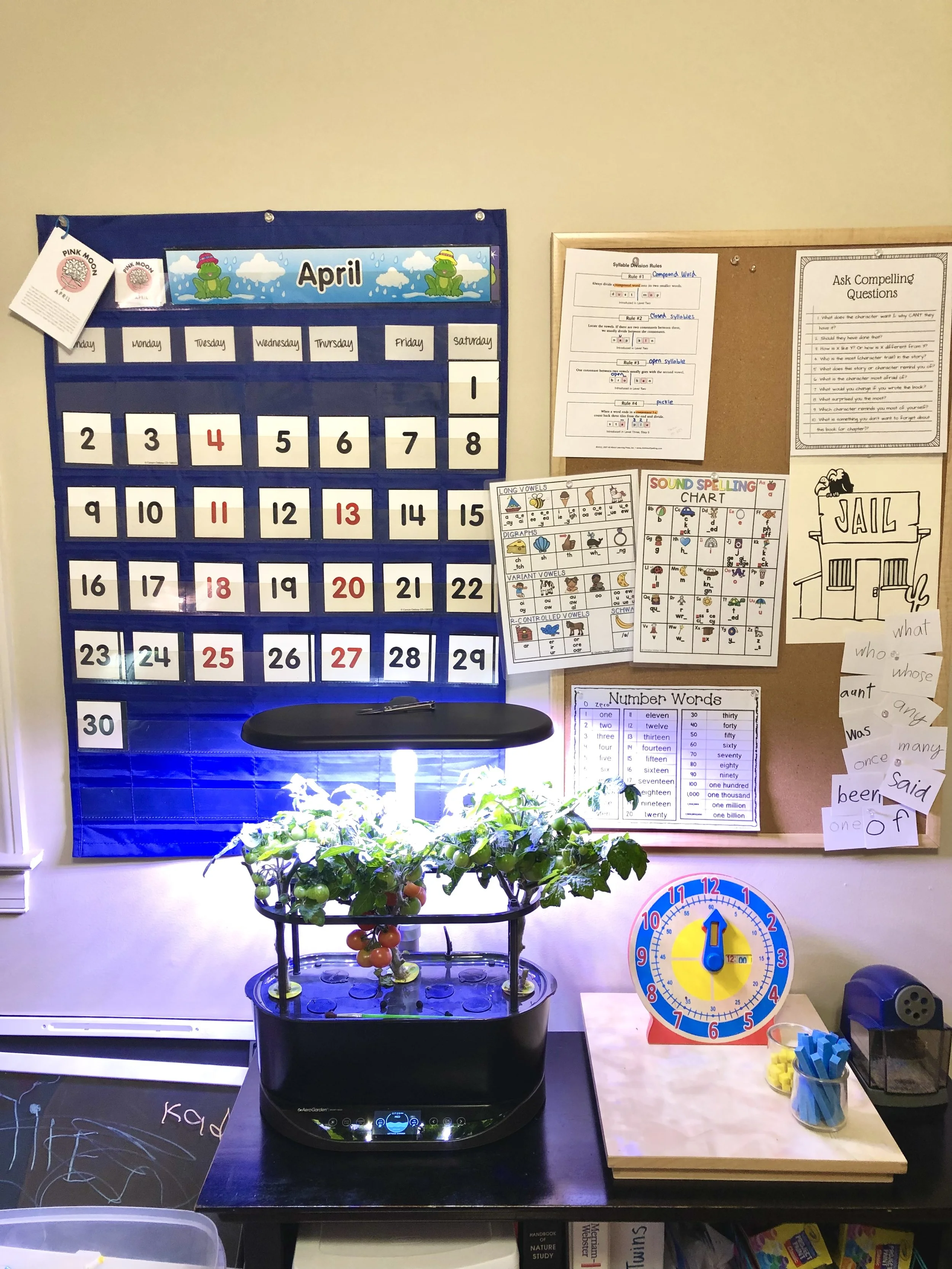
This pocket chart has been up since our oldest was 2! It’s a little forgotten now, but as soon as the littlest starts kindergarten, it’ll be full of post-its with pictures of what the daily plan is - and our sadly small bulletin board. Honestly, the whole wall should be cork with how many pins I need…
You can learn all about lesson planning in this post - and again, don't be freaked out, it's easy!
When you're creating your schedules make time for hands-on and interactive learning.
Kindergartners learn best through play and exploration, so incorporate field trips, experiments, and crafts into their learning. This will help your child retain information better and make learning more fun and engaging.
Related Reading: Learn how easy it is to lesson plan and get your whole year planned in a day!
Related Reading: Learning how to plug lesson plans into a homeschool schedule that works for your family! Free templates included!
Don't Forget To Include Physical Activity!
I will defend to my death that physical education is the most important subject you will teach them! You can read more about that in my post, and argue my point if you wish, but I bet you'll end up agreeing with me...
The gist? Homeschool PE is the most important subject you will teach in our current climate of sitting for jobs and generally sedentary lifestyles - set them up with a habit of movement for a lifetime of wellness!
Homeschooling allows for flexibility and freedom, so take advantage of it when creating your schedule and put in some fun movement!
Related Reading: Let me convince you why Homeschool PE is the most important subject you can teach your kids!
Enjoy Every Stinking Minute!!!
Finally, remember to have fun and be patient. Homeschooling your kindergarten can be challenging at times, but it's also a great opportunity for you to bond with your child and watch them grow. There are just SO many benefits and advantages that you are providing them with!
Celebrate their milestones and accomplishments, and always remember that learning doesn't have to fit into a rigid schedule. Take breaks when needed and adjust your curriculum as you go along.
Wrapping It All Up!
Homeschooling kindergarten can be an exciting and rewarding experience for you and your child. Remember to
do your research,
find a community for support and friendship,
choose a curriculum that works for your family,
set up a learning space,
incorporate hands-on and interactive learning,
most importantly, have fun and be patient.
Your little one is lucky to have you as their teacher and guide. Happy homeschooling!
Kindergarten Homeschool FAQ:
How do I homeschool kindergarten in my state?
Check out the Home School Legal Defense Association (HSLDA) to determine your state requirements.
What should I teach my homeschooled kindergartner?
This part is so much fun! So many of the essential kindergarten skills can be taught without a curriculum. Play based learning and real life is the best way to help these young kids learn.
You should teach basic life skills such as being able to listen without interrupting (library story time), waiting patiently (standing in line at the store), taking turns (playing with other kids), communication skills (ordering at a restaurant), respecting resources (hands on activities and nature walks).
Is it better to homeschool kindergarten? Are there any advantages?
Homeschooling a kindergartner has many advantages over traditional schooling, including increased flexibility and the ability to tailor the curriculum to your child's individual learning styles and interests.
Homeschoolers can get more individualized instruction in reading and writing, have more time for play, gain personalized moral guidance from their parents, and get hands-on learning experiences.
What is the best homeschool program for kindergarten?
The best kindergarten curriculum is the one that you enjoy teaching and keeps your kiddo engaged and having fun! This can be an all-in-one, something you piece together, or something you create on your own!
Find what works for you from Cathy Duffy’s awesome site!
How can I help my homeschooled child make friends?
My best advice is to use social linking to help homeschoolers make friends. Honestly, this system works to help anyone make new friends - kindergarten kiddos and adults alike!
What should homeschoolers do on the first day of kindergarten?
They should eat a fun breakfast, take lots of photos, and do something to celebrate such a big day! The first day of kindergarten is a huge milestone in anyone's educational journey - celebrate!
As for schoolwork, I like to start slow and easy. Read aloud, take a nature walk and count things you see, and maybe do a page of something fun - like a maze! It's not fluff, it's strengthening pencil-holding muscles, improving hand-eye coordination and fine motor skills, plus building focus!
How can I make sure my homeschooled kindergartner has fun?
One of the best ways to ensure your kindergartner is having lots of fun is to incorporate play based activities into as many learning activities as you can. Children learn through play!
Have some educational toys or games on hand for them to explore, such as plastic animals and puzzles. Implement game-based learning activities that require problem solving and collaboration – this helps them develop critical thinking skills in an enjoyable way!
You should also make sure your little one has time each day for free play with friends – either virtually or by playdates! This provides a great opportunity both for social interaction and creative playtime with their peers.
You can incorporate fun activities like crafts, dress-up games, scavenger hunts around the house (which are very popular among kindergartners!), and hide-and-seek outdoors -the possibilities are endless!
Don't forget about traditional educational activities – like reading stories together, counting things you see, or even baking cookies! These provide valuable opportunities for learning that will also bring smiles to their face. Homeschooling kindergartners can be so much more than just textbooks; get creative with your daily plans and reap all of the amazing benefits that come from it!
What are some tips for homeschooling success?
I have a post with 5 tips for homeschool success that will definitely help any family starting their journey with homeschooling kindergarten! I briefly go over each of the following tips:
Play a lot!
Explore New Places
Don't Rush It
Stay Relaxed
Don't Put Pressure On Yourselves
You Got This!
If there’s anything you need help with or have questions about, let me know! I’m happy to help :)
Fresh Posts to Check Out