History Quest - A Solid Secular Elementary History Curriculum
This post is about the History Quest curriculum. You can see more on the Pandia Press website.
Finding a secular history curriculum is a lot easier now than it was just 10 years ago. Often secular families would resort to using Story of the World, but with trepidation regarding references to religious beliefs.
History Quest is a great option for anyone looking for a secular, chronological, story-based history curriculum.
We started with History Quest in 2020 and while we’ve altered how we use it to fit our learning styles (I explain below), I love it as our spine!
If you’re interested in more ideas on how to supplement & up your homeschool game, I include easy ideas each week on a different topic - from behavior & motivation to math manipulatives & spelling suggestions. Check out my one-paragraph newsletter, Seeds For Thought.
This particular curriculum's effectiveness is partly due to the comprehensive history quest study guides that include activities, readings, discussions, writing assignments, and more.
I dare say my (current) favorite part is the audio file…
Product Description
History Quest is a secular curriculum designed for elementary age children (1st-5th grades). It covers history in a chronological format using four different programs, each taking roughly a year to complete.
The four books in the History Quest series are :
What's included or required for History Quest
I go over each of these materials below, but here’s the gist:
You'll definitely need a book or an audio file.
You will need the Usborne Encyclopedia of World History.
You'll also want the study guide if you plan to follow the curriculum's activities.
History Quest Books

The books are where the story is. You can either read aloud or choose the audio version (or buy both if you really want).
I initially tried to do it all as a read aloud, but then happily paid for the audio version. I was destroying the pronunciation and was dreading reading aloud.
The narrator does a fantastic job and it's ridiculously easy to listen from my Google Drive - we'd often listen to a chapter while in the car.
I no longer buy the books - I get the audio.
Usborne Encyclopedia of World History

You’ll need the Usborne Encyclopedia of World History. It’s where the internet links are and it has awesome information and great pictures.
It is also a history spine for multiple levels of Build Your Library.
History Quest Study Guide

The study guide is where the curriculum pacing and activities are. They're woven into a weekly layout where each lesson follows a consistent learning experience.
It is what helps guide and pace you through examining multiple resources like books, internet links, making maps, timelines, and more
I made the mistake of thinking you needed a study guide for each kid, but you don't.
The study guide is for the person teaching the lessons. You can photocopy the master pages like maps and coloring pages from the back for each kid.
Using Build Your Library with History Quest
Another option is to follow Build Your Library Level 1: Ancient Times and Build Your Library Level 2: The Medieval World, and use their pacing guides instead of the History Quest Study Guide.
BYL doesn't use the activities from Pandia Press, but they integrate the curriculum with their own pacing guide and supplemental materials.
The second time we did History Quest Early Times (yes, we’ve done it twice), we followed the BYL Level 1 pacing and supplemental books and loved it! This made it even more literature-based history and was a better fit for my story-loving kids.
How is the Material Covered?
If you follow the curriculum study guide, there is a very clear weekly format that includes reading, and student pages with writing assignments, map work, timelines, hands on activities (like making a ziggurat), and exploring internet links.

It’s admittedly more than we want, so we pick & choose what appeals to us.
When we first started (first & second grade), it required more written and verbal expression than my kids were used to so it was a lot of discussion and narration. I did love that the format allowed me to build up their critical thinking skills.
If you enjoy history, the guide gives you plenty to cover with suggestions for extra reading, plus those internet links for even more exploration.
This curriculum's approach provides a thorough understanding of world history for little kids through its diverse, age appropriate activities and resources.
History Quest Reads Like a Chapter Book
What makes this curriculum so awesome is how it teaches history through story. It reads like a chapter book with each chapter being a different section of history.
For example, chapter 5 in Early Times is about Ancient Egypt. Then, every few chapters you take a History Hop where you're reading a chapter with a first-person narrative - you are the character in the story! You're traveling through time and you are IN that period!
So the History Hop for chapter 5 has you IN the embalming room while they are making a mummy - King Tut's mummy! It even mentions how it kinda stinks and the chief embalmer lets you in on a little secret, sometimes they mess up!
Hygge History Units
Another fun part of the curriculum are the Hygge history units. Every few weeks you take a break from the curriculum and read historically significant literature.
It's like a cozy ancient history literature study!
For example, when in early civilizations, you pause for a week to read a children's version of the Epic of Gilgamesh and related stories.
How We Use History Quest Early Times
As I mentioned before, we have done it twice now.
When we first started, the kids liked the stories but honestly didn’t remember much. We did the timeline, some of the activities, map work - I tried to follow the study guide, but it was too much for their ages (1st & 2nd grade).
I stopped because I had better things to do than teach them lessons they’d forget.
We came back when they were in 3rd & 4th grades with a change.
I did not use the study guide. I used History Pockets activities (which they LOVED) and I used the Build Your Library: Level 1 pacing guide.
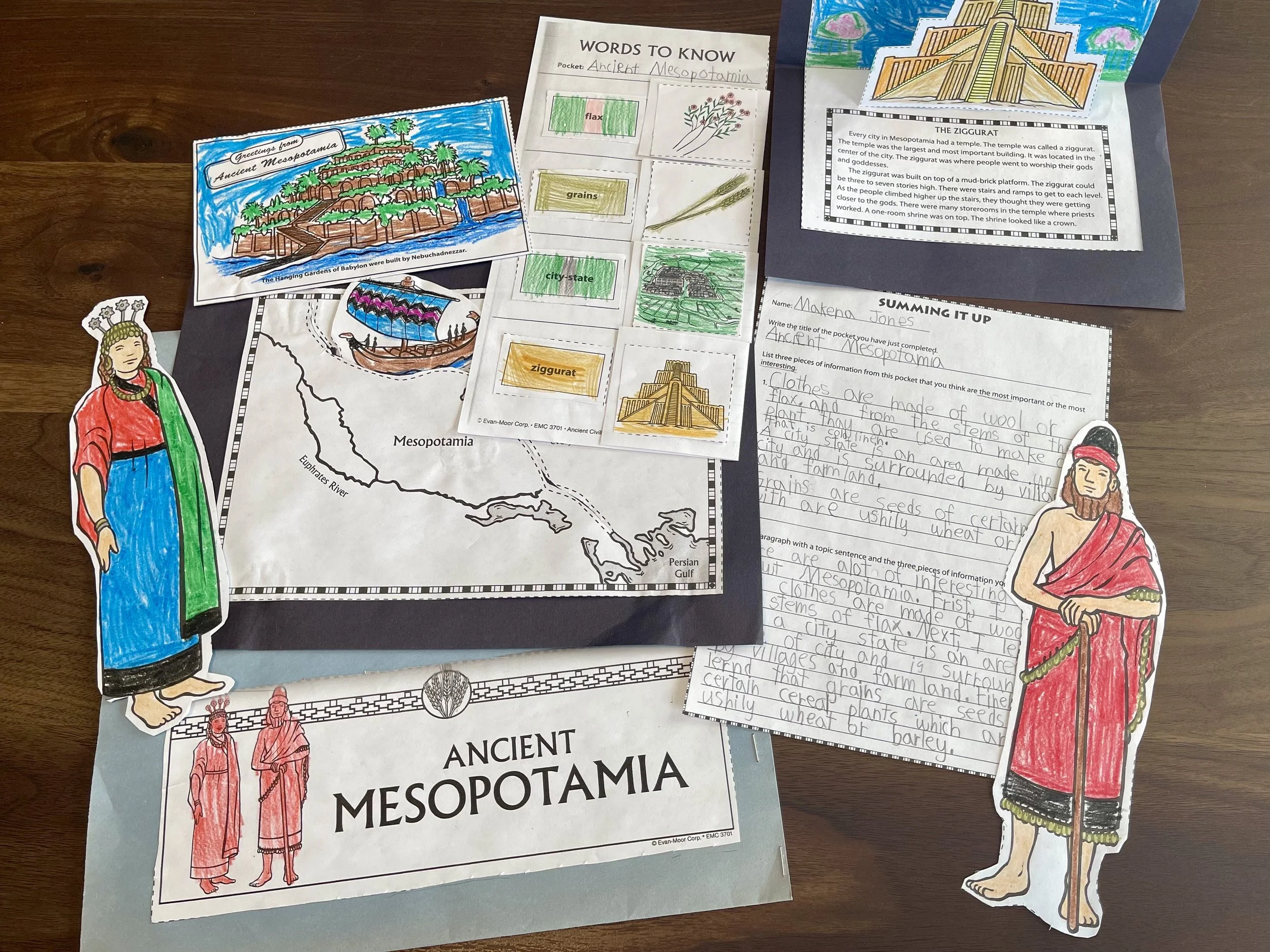
This is work from the Ancient Civilizations History Pocket
History Quest was now perfect for us.
History Quest + History Pockets
I bought the History Pockets in used condition for cheaper, so I bought a bunch and did various activities from each.

These are a few projects from the Ancient Egypt History Pocket
History Pockets for Early Times:
I did not use History Pockets for Middle Times - we used the BYL (Build Your Library) guide and reading supplements.
There are also pockets that you could use for History Quest United States. We have not, but a few options might be:
I truly believe you could have a very nice history curriculum with History Pockets and a History Quest book. They supplement each other nicely and the pockets have great units of information that supplement what’s learned from the books.
History Quest Early Times FAQ
What Ages or Grades is History Quest Intended For?
This curriculum is geared for elementary age children.
Their website suggests starting around first or second grade according to their curricula map.
I found my kids didn't remember very much that young, so we stopped. However, around 3rd & 4th grades it became very engaging and we went through the material faster than the curriculum had paced.
What is the difference between History Quest and History Odyssey?
Age. The two different curricula are designed with different age appropriate levels of information.
The material for History Quest is more age-appropriate for littles given the horrors of history. Also, is not designed to be an independent read.
History Quest vs. Story of the World
I get asked this a lot and I honestly don't know. I don't have experience with Story of the World.
Is History Quest a Good Curriculum?
I think so. It is definitely a secular history curriculum - moreover, it's neutral. It covers information in an engaging way without bias, which I appreciate.
The curriculum is one of my favorites to recommend to families who are struggling to find a good fit for a history curriculum.
It is thorough and can strengthen critical thinking skills with all of the guided activities presented. My kids love the history hops which helps build their empathy for people who lived in those times.
Open & Go Curriculum
Everything is spelled out in a very well-written curriculum. There is very little planning other than gathering materials for your hands on activities or making some photocopies of map work.
However, it is also flexible, so if you don't want to do everything, like the history travel log or hands on activities (*ahem... me*), you're not skipping key parts that might create gaps in learning.
Multisensory and Hands-on
This is great for some families, but this wasn't a good fit for us. We're not crafty, we’re bookish.
I did some of the activities with the kids but found that when we used the Early Times audio with the Build Your Library pacing, the integration of literature and history made the curriculum really come alive for us.
More From Pandia Press
Just so you know, Pandia Press also makes secular science curricula.
We started using their REAL Science Odyssey last year and my kids really enjoyed it.
You can check out it on their website, or you can read about other options in my post on secular science curriculum.
More On Homeschool Curriculum