Handwriting Without Tears Review
Handwriting Without Tears and Cursive Curriculum Review
First, these thoughts are my own. The company that makes this curriculum, Learning Without Tears, doesn't know I exist (besides my purchase history). Second, I make zero money for promoting this fantastic program - I love it!
Buy it. It’s fantastic. It works.
From my years teaching public school, I'd always heard the intervention teachers mentioning Handwriting Without Tears as having the best instructional methods for helping young students gain confidence with handwriting instruction.
So with zero research into any other handwriting program, I jumped online and bought the Handwriting Without Tears student workbooks to teach my kids handwriting. No regrets.
We have used this curriculum since the start of our homeschool journey. We have had incredible success with my children learning proper letter form. It’s still a staple in our homeschool schedule since my older kids currently use it to practice their cursive
We have integrated a student workbook into each year of our homeschooling from kindergarten through the fourth-grade level, from print through cursive.
Here's a rundown of both of these fantastic print and cursive programs
Program Description
Handwriting Without Tears is a series that help kids with learning letter formation, including lowercase letters, uppercase letters, number formation, and even cursive at higher levels.
The program is broken down by generalized grade level, starting with pre-k letter formation to cursive handwriting.
Handwriting without tears lesson plans aren’t really a thing - it’s set up as a workbook that doesn’t have a suggested pacing. I’ll discuss appropriate pacing below.
In addition, the company has other curricula with language arts lessons. I'm only going to cover handwriting in this post.
Which Handwriting Without Tears Level Do I Start With?
It can be confusing to figure out which workbook is for which grade. This is because the books are color coded instead of having a grade level written on the cover.
Toward the bottom of the post, I will clarify which book is for which level.
Kindergarten and Preschool Handwriting
The very beginning of the program starts below the kindergarten level with a more tactile, sensory approach to letter formation.
The hands on materials include various items such as wood pieces, chalkboards and little chalk bits, little sponge cubes, and a character named Mat Man.
These would be great at a pre-k level to teach children too young for proper pencil grip or lack fine motor skills or strength to be doing workbook-type practice.
Having hands on materials is always fantastic for building a foundation for learning any skill, and this provides that.
I have yet to gain experience with this aspect of the program. We'll skip it with my 4-year-old as she's already pretty strong with pencil grip and fine motor coordination. We have done tons of fun stuff with hands on materials like play-doh, kinetic sand, coloring with fat and skinny markers, safety scissor work, beading on pipe cleaners, and so on.
Related Reading: A Beginner’s Guide to Homeschooling Kindergarten - the complete guide to a successful year!
Early Elementary Handwriting
Once kids have a grasp of proper letter development, it’s easy to keep to just keep using the next book in the series.
The changes for the elementary leveled books are:
the print size,
the line size,
the number of words per page,
the vocabulary used, and
the amount of writing the child is expected to do.
Mid to Late Elementary Handwriting
We stop doing handwriting and switched to cursive around 2nd grade. However, I will happily go back to print practice if my kids’ handwriting starts to get sloppy as we progress with writing demands.
Like I tell my son - handwriting improves until it doesn’t, and then it just goes downhill. If they can’t read your writing at 9 years old, they definitely won’t be able to read it at 49.
Handwriting practice is not a punishment, it is a legitimate life skill!
Student Workbook Design
Graphic and Visual Clutter
The books are not printed in color, but they have some cute graphics that can be colored if your kids are interested. These are by no means coloring pages. Instead, the focus is on having students practice a single or a few letters per page.
Overall, the pages are set up with a clean, non-distracting design. It's a very well-designed curriculum that avoids any coloring book feel and helps kids stay focused.
Self-Corrections
At the end of a section or page, there is usually a box the kids can use to remind themselves to check their work. For example - do the tall letters reach the top?
This little section helps remind the kids to self-correct their letters. My children loved this part. But, of course, they're suckers for checking stuff off, so while super simple, it's also quite motivating!
How are the lessons set up?
Since there's no definitive guide or suggested schedule, anyone is welcome to pace the workbook and its sections to match their needs.
I am a big fan of having students build their stamina to avoid burnout and pushback for all lessons - especially writing. Therefore, having my kids practice only 1-2 pages of writing each day was sufficient for helping their form and reinforcing the correct use of pencil grip.
I suggest starting with only 5-10 minutes per lesson to ensure no frustration or tears (so to speak) when it's time to pull out the printing book. You need to build their hand strength first! We certainly didn't start with 2 pages in our daily lesson plans!
Related Reading: How to lesson plan for your homeschool like a rock star! The easy way to get organized - done in a day!
Letter Formation Progression
With this curriculum, students are gently taught how to form letters on practice pages that build upon letter formation skills.
For example, the first letter learned is c. Once kids master c, they move onto a more significant hand motion with o. So on and so forth, the curriculum builds until all of the letters have been taught. Some curricula seem to ignore how handwriting builds and simply teach the by copying letters in ABC order.
Lowercase Letters
I like to teach lowercase before uppercase because they are used much more frequently in writing. Therefore, I skipped the sections on the uppercase form until I felt they had mastered lower.
Uppercase Letters
I cannot speak to the Pre-K practice books, but there's no significant over-emphasis on learning uppercase or capital letters over lowercase.
In the Kinder level book, uppercase comes first, but it's only a few pages, and they use images of the block letters from the preschool curriculum to teach it. You don’t have to have the wooden pieces for the child to see how they’re formed. It’s a simple visual and helps them see the letter built differently.
Writing Numbers
I didn't have my children use the sections that taught how to make numbers because that's covered in our kindergarten math curriculum.
They weren't huge sections, so it wasn't a waste of money not using them. However, it was by no means a focus of the book - it felt more like a bonus in addition to the letters.
Do you need the teacher's guide?
Nope. There isn't one for the workbooks. They are very self-explanatory, and your student can be very independent.
Students will benefit from your guidance when first starting Handwriting Without Tears so that you can make sure they understand the different styles of the letters and how they're to form them.
It's also a good idea to make sure they understand the purpose of the curriculum is learning how to form the letters so that they take time to do it correctly.
I like to have my kids point out or circle the letters or words on the page they think are their best work.
Why Children Should Master Proper Handwriting
Handwriting is huge. When children learn to write, they build muscle memory to form letters. Initially, it is a laborious process that requires new muscles, concentration, and frustration.
However, once kids begin to write with automaticity, the strain lessens, and writing becomes easier as the focus shifts from letter formation to thought processing.
When kids master handwriting, the process is more efficient, and they can quickly get their thoughts down on paper. This speed comes in handy when taking notes or free writing and trying to keep up with the ideas bursting inside their heads!
Should Kids Learn To Write In Cursive?
Opinions on teaching cursive is a whole other post, but my teaching philosophy includes cursive as part of our language arts curriculum! It’s important to add cursive to one’s handwriting skills!
Long story short - it reinforces proper letter formation and left-to-right directionality, makes reading easier for early readers, helps children with disabilities such as dyslexia and dysgraphia, is faster to write, and even has some speculation that those who write in cursive are smarter!
When Should Kids Learn to Write in Cursive?
I am a big fan of exposing children to cursive at a very young age. I do teach print first, as it's what's seen more often out in the world, but cursive starts right around first grade for my children.
And yes, we love love love the Handwriting Without Tears cursive programs.
Handwriting Without Tears Cursive Curriculum Review
When I taught in public school, I taught cursive. It was an awful curriculum that taught letters individually and in ABC order. It was terrible, and the students struggled. The letters bounced around from super easy (c) to crazy (b and z), and connections were sometimes super intimidating (b to r?)
The Handwriting Without Tear’s cursive instruction is written in a super simple sequence that makes learning cursive a breeze! I love this curriculum and highly suggest it.
There IS a Teacher's Guide for cursive! I never used it as I taught this in school, but anyone intimidated by teaching cursive might find it helpful.
Letter Instruction Sequence
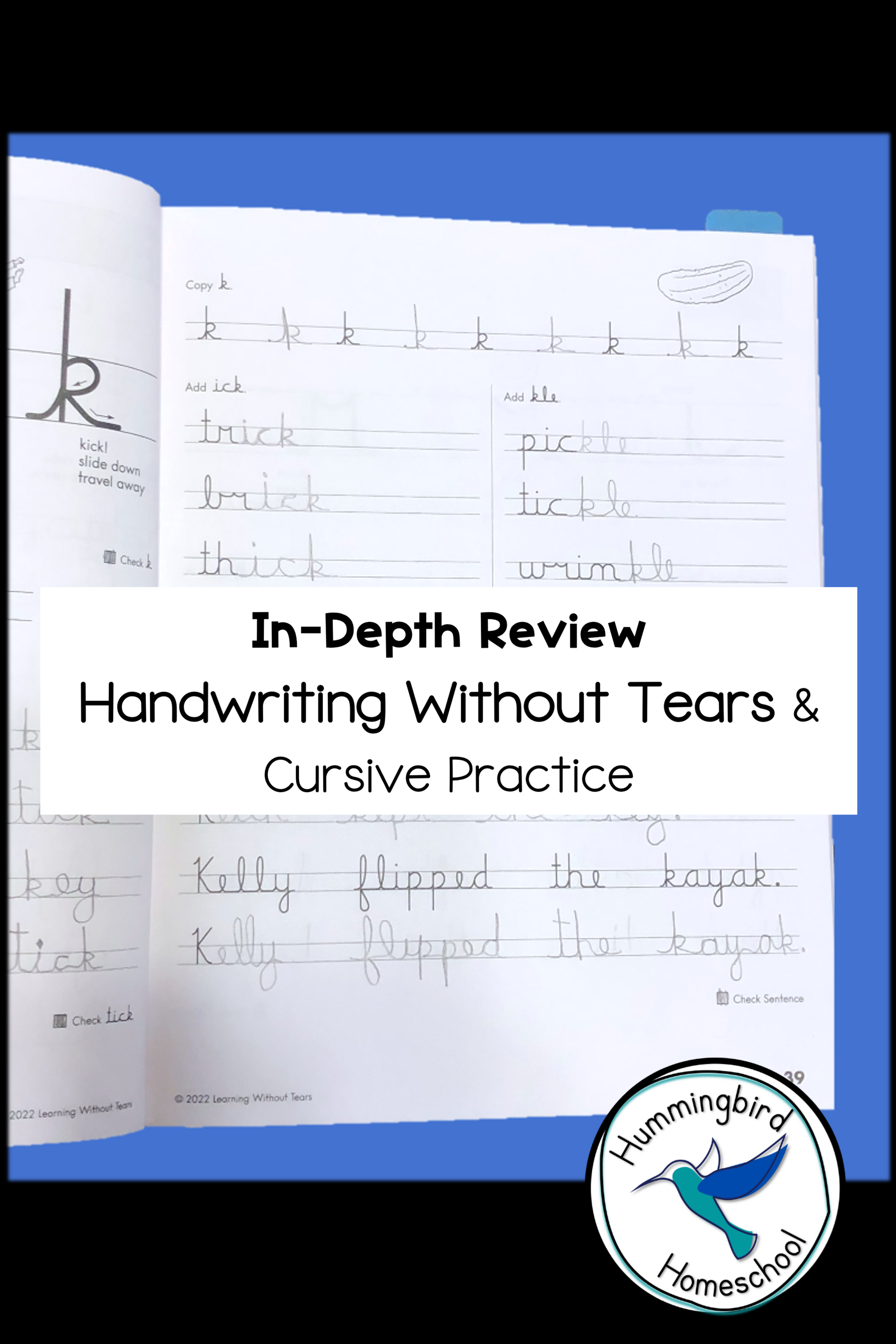
The Cursive Kickoff workbook suggests starting in 2nd grade, but I've used it successfully in 1st grade. To start the book, it has students practice print letters before moving on to cursive and only touches on capitals before teaching all of the lower.
Like print, letters are started with minimal movement (c) and build upon those hand motions. This program also uses a less formal form of cursive, not emphasizing extra loops.
Cursive letter connections are taught right away rather than waiting until the entire alphabet has been covered.
Indeed, the connections are introduced in a very thoughtful manner. Moreover, the lessons are taught in a way that builds cursive gradually, moving from easy to more challenging.
Cursive Program Levels
The first book to cover cursive is Cursive Kickoff which is meant to be started in 2nd grade. It begins with printing practice and transitions to cursive.
Cursive Handwriting is for 3rd grade and has print review, and Cursive Success is for 4th grade and does not have printing practice.
These grade levels are subjective and can be used when that level of instruction is appropriate. However, I'd recommend staying roughly around the grade level since there is an element of reading comprehension to understand what is being written at the higher level.
What Handwriting Without Tears level do I choose?
This curriculum is written according to suggested grade levels, but that grade level isn't reported on the cover. Each cover is color coded instead. That can make it tricky to know if you have the right book.
Remember that these grade levels are subjective, and your student's instructional needs should dictate the book you choose.
Here are links to each book on Amazon so you can preview them better.
Printing Workbooks
My First School Book - LIGHT GREEN book for Preschool
Kick Start Kindergarten - PURPLE book for Transitional Kindergarten
Letters and Numbers for Me - ORANGE book for Kindergarten
My Printing Book - YELLOW book for 1st grade
Printing Power - GREEN book for 2nd grade
Can-Do Print - YELLOW book for 5th grade with language arts activities
Cursive Workbooks
Cursive Kickoff - LIGHT (BRIGHT) BLUE for 2nd grade
Cursive Handwriting - ORANGE for 3rd grade
Cursive Success - DARK BLUE for 4th grade
Can-Do Cursive - GREEN for 5th grade with language arts activities
Final Thoughts
Handwriting Without Tears is a fantastic program that can grow with your homeschool. It can easily be integrated alongside other language arts programs you may be using because it takes less than 10-15 minutes a day.
Of all the handwriting programs you have to choose between, I’d say this one tops the cake.
On a side note, they're also available in languages other than English - which may be a bonus for some!
Is it affordable?
Yes, I believe it is. The student workbooks are less than $12 each directly from their website. Depending on the book, they are available on Amazon for slightly more, around $12-14.
I prefer purchasing from Amazon when I don't know the exact level, as the return process for being a Prime member is much easier than working directly with Learning Without Tears. Their return process takes a bit of time and effort.
Overall, I highly recommend Handwriting Without Tears!
Fresh Posts To Check Out