
Homeschool Lesson Planning Made Easy
Lesson planning. Sounds kinda scary, right? Well, no worries because it's genuinely not as daunting as it seems - and most homeschooling moms enjoy it!
The lesson planning process was covered while I was in the teaching credential program, but the real education of planning, the bread & butter, happened while I was in the trenches with public school.
Here's The Gist For Creating Your Homeschool Lesson Plan:
Find your curriculum's pacing guide.
Teach your children to get a feel for the lesson plan pacing
Flex your math skills and do some lesson planning math.
Write your subject into you homeschool schedule.
Plan out your schedule for the week.
See how the lesson plan fits into your daily planner
Now the fun part! Let's see how this all work...
Why Homeschooling Parents Need Lesson Plans

Not having any homeschool lesson plans is a long dark road to chaos… though probably a fun one!
Your family homeschool journey is different from public school. But you still have to engage students (ahem, your children) with learning main subjects and follow basic state requirements.
If you don't plan, you risk getting wildly behind, plain & simple. Far too many squirrel moments will steal your focus away from your homeschool obligations.
It's one thing to say you'll be consistent, but if you don't have a basic schedule to pace yourself, it's like trying to conquer the wild west with a bunch of wet kittens.
Trust me, even if your wet kittens only happen to be in kindergarten, you’ll still benefit from having some homeschooling kindergarten lesson plans! If your kittens are older, it’s even more necessary to structure that time!
Related Reading: Popular books for cheap! Keep your kids in the social loop without breaking the bank for birthday and holiday gifts by using Scholastic Book Clubs for Homeschoolers!Getting Started Making Your Homeschooling Plans
Grab your curricula, some scratch paper, and your favorite pen - and if you don't have a favorite pen (or set!), then literally stop everything right now and go to Staples.
Every homeschooling parent needs awesome writing utensils. Don't walk; run to the pen aisle. Have fun! I promise you, making lesson plans with a fun pen is like having a drink with an umbrella. It's just better.
While gathering supplies, grab a monthly calendar. Then, with your awesome pens, write in your family vacations, extracurricular activities, and other time commitments.
How Do You Organize Lesson Plans For Homeschooling?
Believe it or not, the easiest way to get your homeschooling lesson plans together is to plan the whole enchilada - your entire school year at once.
Once you have the year overview, you work backward and go monthly; then, you work out your weekly schedule. Your daily lesson plans will be very apparent at this point.
How you actually organize your materials will vary. For example, some like to rip practice sheets out and keep them in a file box by day, and some create binders.
I'm all about making life easier. I refuse to give myself extra busy work or something else to keep track of (daily binders, loose pages), so we use consumables as they are. We write in books.
Our homeschool setup organizes the curricula by child. We keep our own curriculum in nice metal file bins. Robust and compact. What isn't currently being used is stored in a large plastic container.
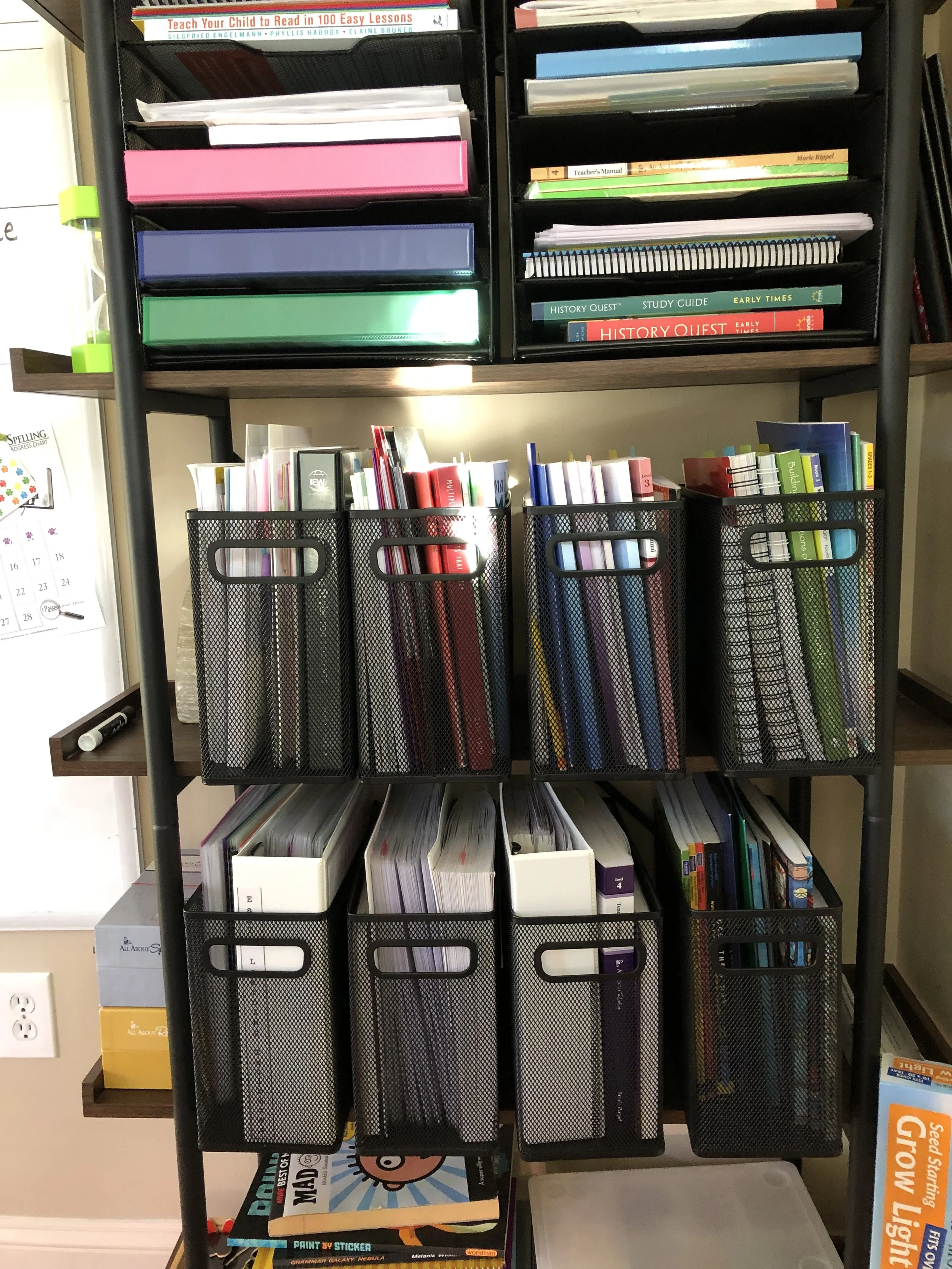
Annnnnnd… here’s how we organize homeschool curriculum and paperwork! The kids grab a bin off the shelf (both from Target), and off we go to learning land!
Using Homeschool Curriculum For Lesson Planning Your Whole Year
You will need your upcoming term's curriculum in front of you. All of it.
Start with one subject and crack that bad boy open.
In the front of most curricula, you will find a pacing guide from the author or publisher. This is the recommended pace that the curriculum was designed for.
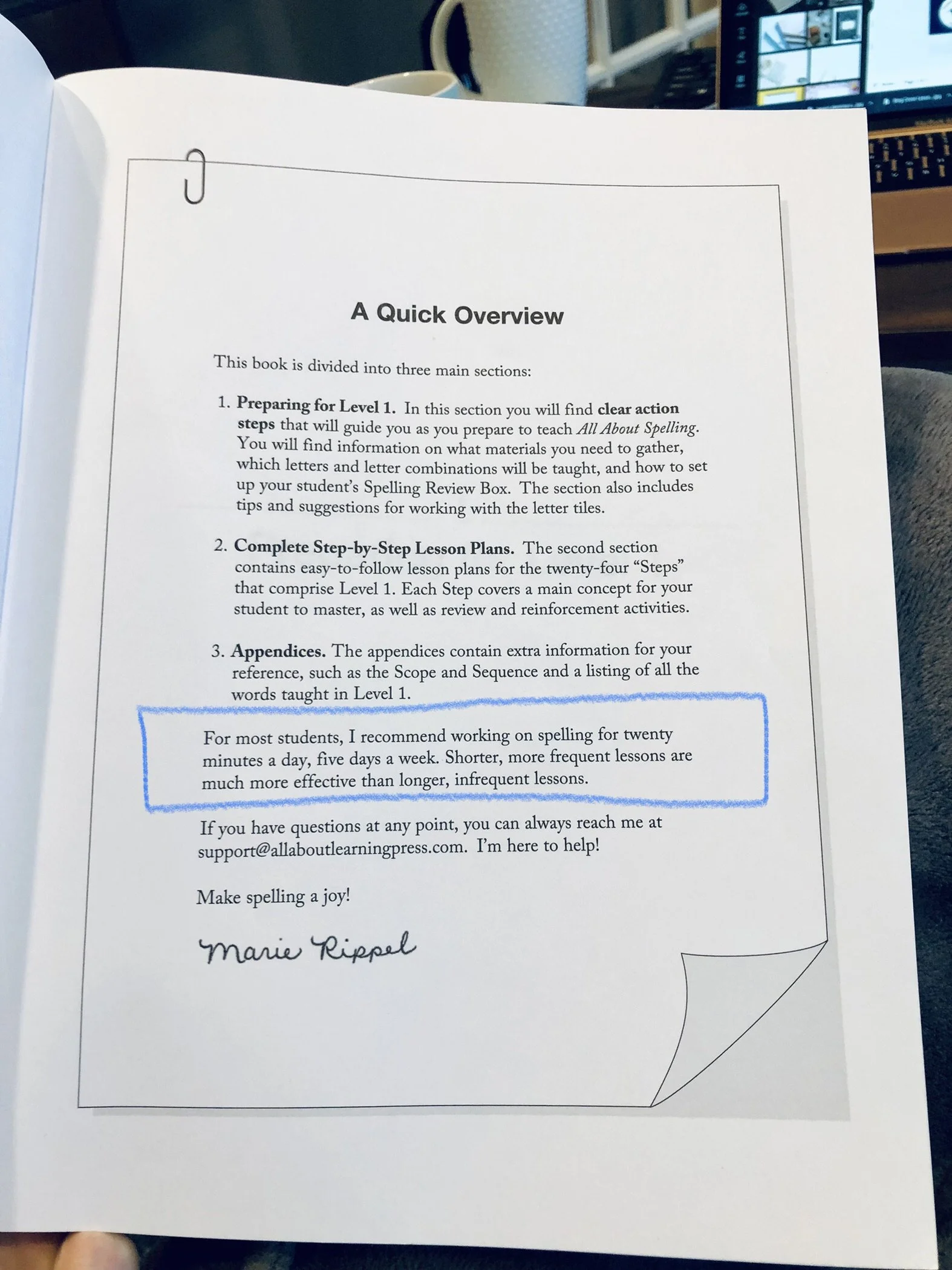
This is the pacing guide in the front of All About Spelling, Level 1 - Your curriculum should tell you how to lesson plan
Preview The Material BEFORE Planning!
After reading the suggested pacing, take a week of actually teaching with the material to see how you and your children do with the suggested pacing.
In a school setting, teachers have a pretty solid sense of how long lessons should take (unless they're new teachers) because the material is generally familiar.
With new-to-us homeschool curriculum, I have no clue how my children will interact with the material.
We do a week(ish) long trial before I dig in and do lesson planning for the school year. This gives me a good sense of how the materials work together and the sequencing of the lesson plans.
Pacing Lesson Plans For The Entire Year
After knowing how your children interact with the lessons, hunker down and start lesson planning.
Here's an example of how I plan for our reading curriculum, All About Reading.
After doing a couple of reading lessons, I found that both of my children were OK with a lesson a day, and my son did well with 2 lessons a day. His brain needs compaction and accelerated pacing, so this wasn't surprising.
I plan on writing a more in-depth post on how to plan for gifted learners that require compaction and acceleration in some subjects - stay tuned if that applies to your family!
Divide The Number Of Total Lessons By The Length It Takes To Teach
With Level 1 being 53 lessons, I need to account for 53 days of reading lessons for my daughter.
I plan for 4-day school weeks. 5 is unrealistic and unnecessary with the focused teaching that comes with homeschooling.
For my daughter, here's my lesson planning math:
53 lessons divided by 4 days equals 14 weeks out of the school year
Knowing that, I take my monthly calendar (with family vacations and extracurricular activities already written in!) and pick 14 weeks for reading lessons.
At the end of those 14 weeks, I do this same process for the next reading level!
I wash, rinse, and repeat with all my other resources' lesson plans for math, writing, etc.
What If My Children Take Longer Than The Pacing Suggests?
I got you! Things aren't always clean. Don't worry - it's easy.
I know my writing curriculum (IEW) is broken into 24 weeks from start to finish. However, I know my children need 4 solid days of work to complete the curriculum's suggested week. They're young and slow. That's cool - there's no rush!
I know there's no way we'll do 4 days of writing each week without them melting down and hating writing. Plus, their little brains can't do every subject in the morning chunk of time that we typically dedicate to school work.
I plan for 3 afternoons a week for writing. So here's my lesson planning math:
24 weeks multiplied by 4 lessons (per the curriculum) equals 96 writing lessons in total.
96 lessons divided by 3 lessons per week equals 32 weeks.
Boom! It will take us 32 weeks to finish our writing curriculum.
I write that into my calendar - 32 weeks is basically the entire year. I know writing will be a long-haul subject and will probably carry into the following year.
State requirements do not require you to finish the lesson plans any curriculum within a school year! They simply want you to teach the subjects; how and when is your discretion.
I repeat: you are not in trouble if you must slow down and can't finish all of the lesson plans in a curriculum within a year!
Lesson Planning For Seasonal Curriculum
Our preschool & kindergarten curriculum, Exploring Nature With Children, follows the seasons. This one is simple to plan into our calendar because the pacing guide tells me exactly what to do and when.
Building Foundations of Scientific Understanding gave me a heads-up in the pacing section of timing for specific units. (NOTE: if you want to use BFSU, this guide is MONEY for lesson planning! The actual curriculum’s pacing is super confusing!)
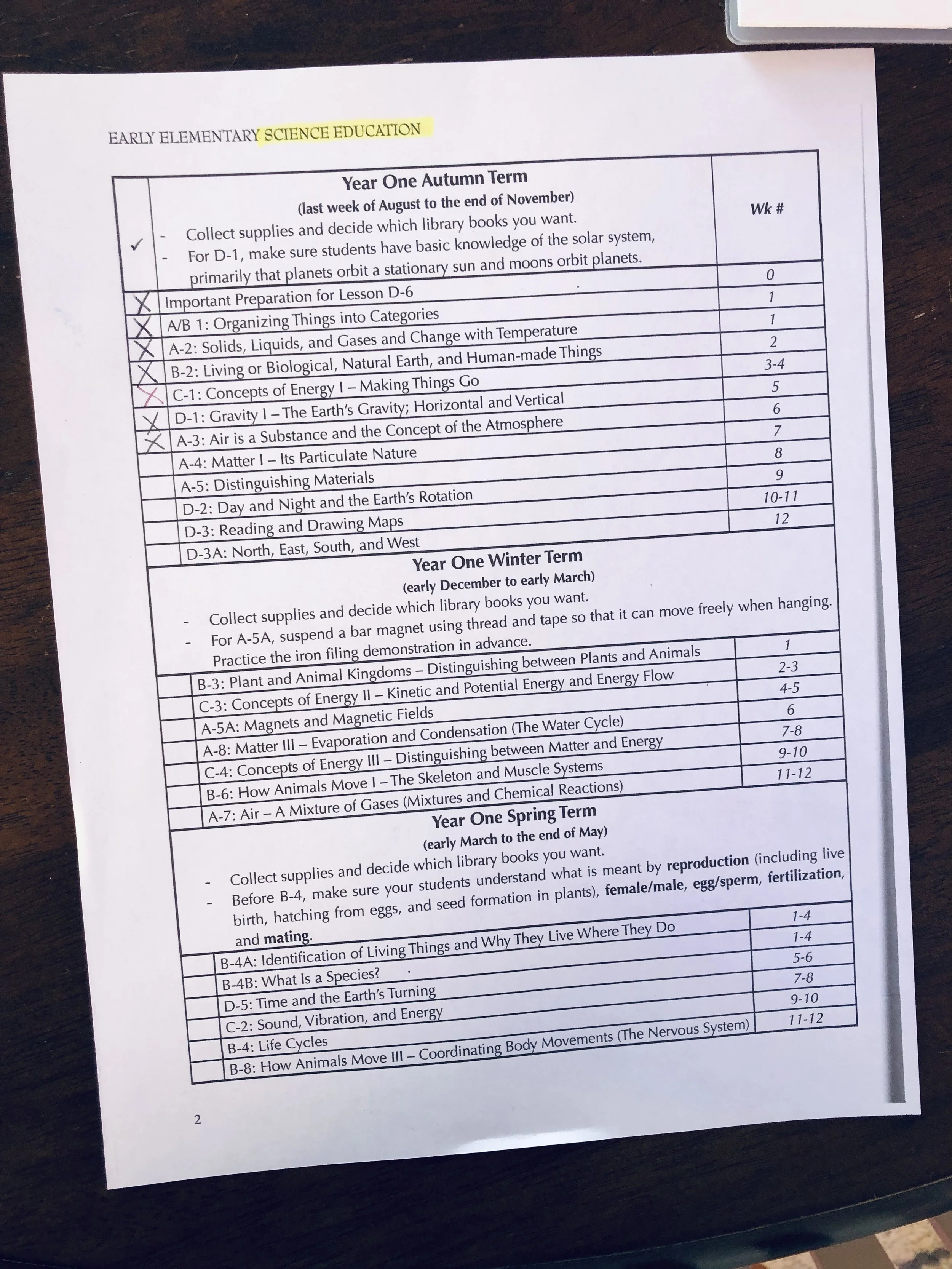
This is 1 of 2 pages of lesson plan pacing and seasonal timing from the homeschool science curriculum, Building Foundations Of Scientific Understanding, Volume 1. FYI, This page is NOT from the actual curriculum! It is from this approved guide - Early Elementary Science Education
Look through your pacing guide - it will tell you! If it doesn't, reach out to the publisher for some help!
Weekly And Daily Lesson Planning
Once you know how long your subjects will take your students to complete, from start to finish, from a monthly view, you can narrow down what is a manageable chunk for weekly and daily learning.
As I stated above, my children's brains will short-circuit if we try to cram everything into a day or week.
What Is A Good Schedule For Homeschooling?
There are many ways to schedule for multiple subjects and different grades! Preschool, kindergarten, elementary, middle, and high school have different needs!
My post on creating your own homeschool schedule has tons of free templates you can download to use, try, ditch, and figure out what works best for your own needs!

This blog post has free homeschool schedules! You can download the PDFs and find what works!
What should a homeschool schedule look like?
There is no need for you schedule lesson plans for more than 4 days a week. A 5-day school schedule is overkill for most homeschools - depending on how many hours a day you plan to teach.
If your schedule only allows for 1-2 hours a day, then you probably need 5 days. Most families I know use a block of time, like the morning, that is a few hours long for their school day. When you chunk out 3-4 hours over a day, 4 days is fine.
I use 5 days to plan 4 days’ worth of material because I know that for one day of the week, I will toss everything to the curb and not do any school. This means we just skip to the next day! I usually toss Wednesday’s learning out the window! We do play dates and run errands on many of our Wednesdays.
What I do for our mornings is a version of homeschool planning called Loop Scheduling.
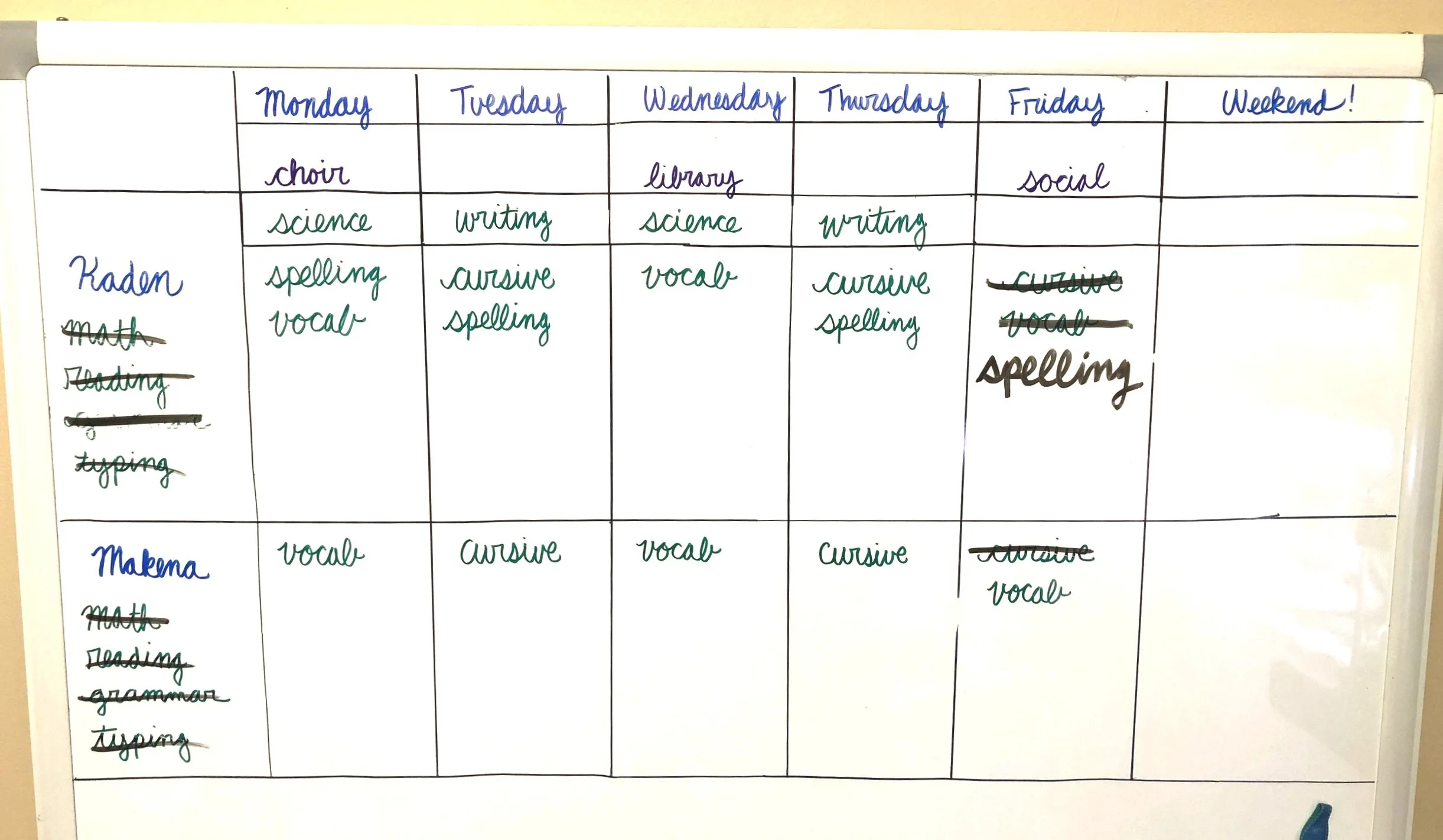
This homeschool schedule changes on Sundays. After doing the lesson planning and creating the schedule early in the year, I basically write the same thing in each week (subject-wise) and plop them into the weekly schedule based on our social calendar. This particular week was before 3 nights of soccer practice started.
Consider that your child is essentially getting private tutoring, from you, and is not having the same distractions and interruptions that are found in a classroom environment. They're being taught at their level with pacing appropriate to their learning - it's so so so much more efficient than a traditional school environment!
What Happens If Your Lesson Plans Move Too Fast?
If you stay on task with your lesson plans, doing a 5-day school week runs the risk of moving too fast for your child and facing subjects and materials that are inappropriate for their developmental level.
For example, if you start social studies young and move too quickly, it is easy to run into content that needs maturity to fully comprehend. History is full of atrocity that isn't appropriate until kids have reached a maturity level to handle it emotionally.
Mathematics gets super intense and detail oriented requiring higher executive functioning skills. Reading material also becomes advanced beyond maturity levels.
Not to mention, you'll run into some serious burnout.
So take your time - hit up the park. Enjoy fun stuff as a family!
How Do I Pace All Of The Subjects I Need To Teach?
A traditional school schedule does not teach each subject every day! Other than daily core subjects math and English, they teach units - like science in the fall, followed by history or something similar.
Writing comes in units as well. Sure, they write daily, but beginning lessons on a structure like friendly letters, narrative, or expository writing - or formatting, editing, revising, or stylistic techniques - are taught in unit chunks.
Art, music, technology, etc., are also taught on a rotating schedule.
When you chunk out subjects as units in homeschooling, this type of scheduling is called block scheduling.
Please do not force everything onto your child all at once! It is super inappropriate, and you will kill all joy from learning.
Your daily lesson plans do not need to cover everything - using a schedule to organize when you want o teach each homeschool lesson will help big time! It'll help you see the bigger picture of your year.
Creating A Homeschool Lesson Plan For Children In Different Grade Levels
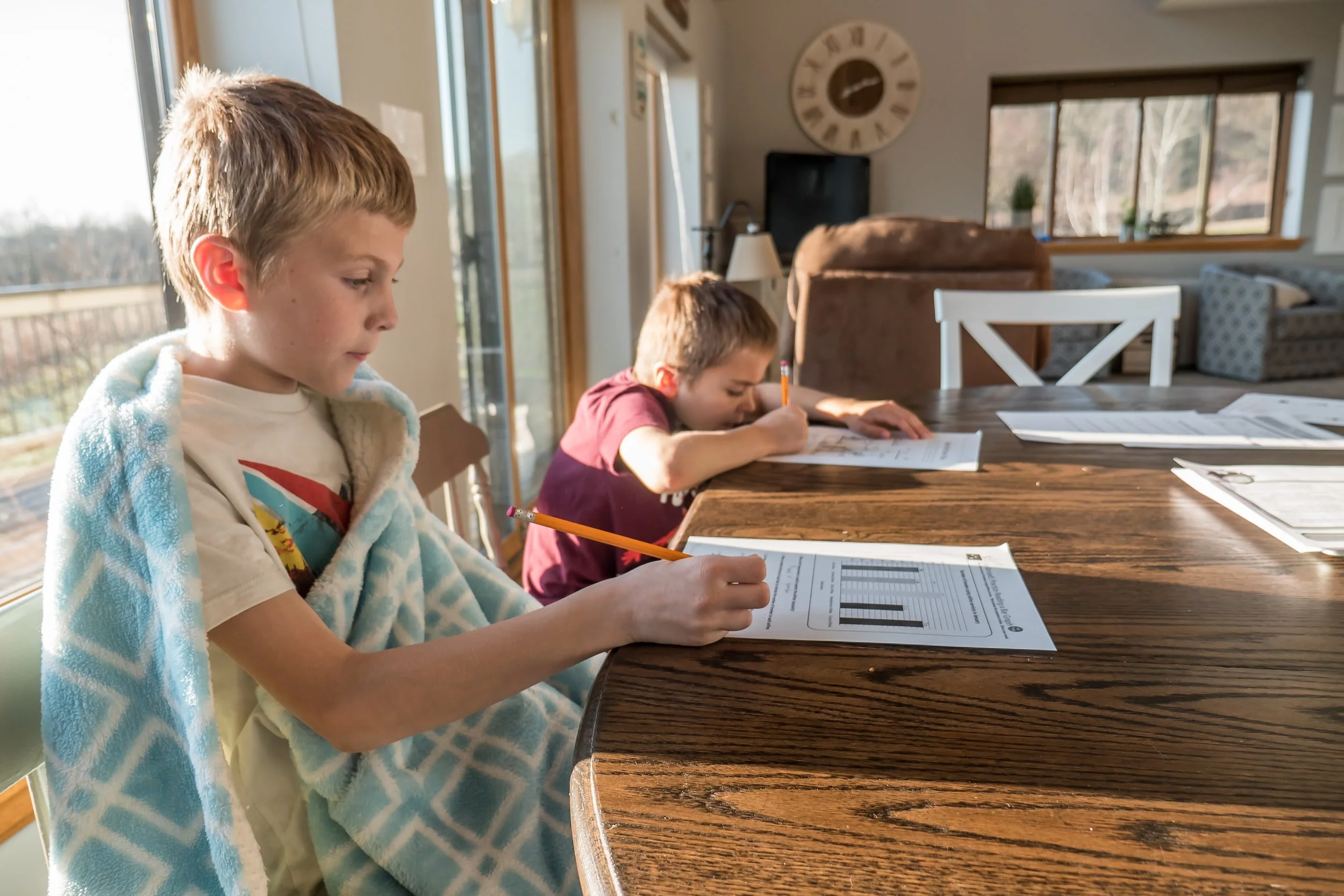
You might have a kiddo in first grade and another at a different grade level that has other subjects and education needs. No problem!
You homeschool. Your kiddos do not need to learn the same topic at the same time.
You take each child's needs and apply the same logic for creating lesson plans. Their timelines for finishing may line up, or they may not, and that's ok.
Summary Of How To Create A Homeschool Lesson Plan
Don't teach everything at once! Use a schedule to map out what you want to teach for the year.
Use your curricula pacing guide to determine how often you teach a subject and how long it will take to finish all of the content.
Test a lesson or two and use your materials to see if the suggested timeline fits your student's pacing needs and ability to focus.
Use lesson plan math to set your calendar up
Be flexible!
The Homeschool Curriculum We’re Currently Using:
Vocabulary (advanced): Wordly Wise - this is challenging, but not exciting
Vocabulary (standard): Scholastic - this is easy, but more engaging
Need More Help With Lesson Planning? I Can Help!
If you need help figuring out how to lesson plan, reach out! I'm happy to help you create a homeschool lesson plan schedule that works for you and your family.
Whether you're new to homeschooling or just need fresh eyes on old material, I can help!
More Posts on Homeschool Organization



Dive into this comprehensive guide that simplifies the process of creating a lesson plan for new homeschooling parents. Discover the benefits and step-by-step instructions to create engaging, personalized lessons